
In international trade, manufacturing, and logistics, many mission-critical processes are not initiated in enterprise systems—they start in email. RFQs, quotations, purchase orders, shipping documents, and packing details often enter an organization through email.
What appears to be a simple communication tool actually functions as a business entry point. Once an email is misrouted, an attachment is misread, or a critical step is missed, the impact can compound downstream—resulting in missed orders, delays, reconciliation exceptions, and even compliance risk.
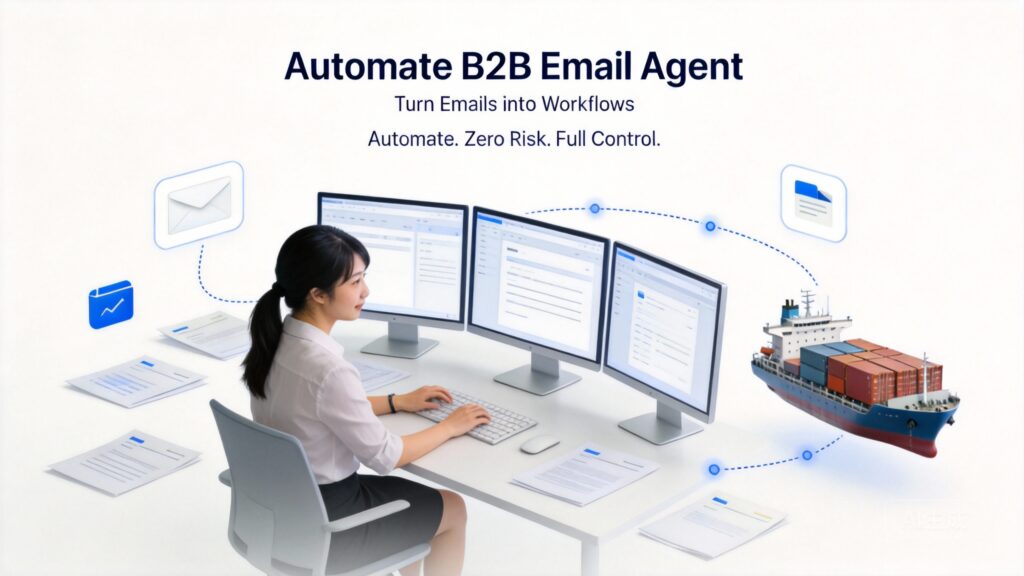
This is where Email Agent delivers value. It is not “an AI that replies to emails.” It is a workflow engine that turns email intake into executable processes. Emails and attachments are treated as business inputs: the system automatically classifies document types, extracts key information, validates against system-of-record data, creates tasks, and drives closed-loop execution. At the same time, every step is backed by an auditable evidence trail—explaining the rationale behind decisions, supporting human-in-the-loop review, and converting corrections into reusable institutional knowledge.
From Email Processing to Workflow Automation
The long-standing challenge for enterprises is not “understanding emails,” but “turning emails into action.”
In real-world operations, critical information is often not in the message body, but in PDF or scanned attachments. The same transaction is gradually completed across multiple rounds within an email thread. And every step is directly tied to delivery, cash collection, and compliance. After the email arrives, people still have to manually enter the information into ERP, CRM, or logistics systems—creating clear breaks in the process and making efficiency heavily dependent on human effort.
For these reasons, the core objective of automation is not to “reply to emails” on someone’s behalf, but to convert emails into structured tasks that flow directly into business systems.
Where to Start for the Highest Automation ROI
In practice, the most effective place to prioritize automation in trade-related email is four high-frequency document types with long, end-to-end process value chains:
Requests for Quotation (RFQs), Quotations, Purchase Orders (POs), and shipping documentation such as waybills, bills of lading, and packing-related documents.
These emails share strong commonalities: attachments carry the core information, templates are relatively consistent, field structures are well-defined, and they directly connect to order fulfillment and logistics milestones—making them ideal intake points for automation with the fastest ROI.
Why You Can’t Rely on “LLM-Only Classification”
Many teams initially try to use large language models (LLMs) to classify emails end to end, but quickly run into bottlenecks in production.
First, the model input is often incomplete—if attachments are not parsed, even the strongest model can only guess based on limited text. Second, business operations require explainability, not probabilistic judgments. Teams need to know which rules were triggered, what fields were extracted, and whether system validations passed. More importantly, the risk of automation is far higher than the cost of recognition errors: the loss from executing the wrong workflow is often much greater than a single misclassification.
A more deployable path is to build reliability into the process itself: prioritize deterministic signals, use intelligent inference as a supplement, and converge decisions through a layered decision framework.
A More Controlled, Production-Grade Decision Framework
A mature Email Agent typically uses a layered decision logic.
If similar emails have been corrected in the past, the system first leverages business memory. Otherwise, it starts with deterministic rules—such as attachment filenames, subject keywords, and sender domains. If that is still insufficient, it moves into structured extraction and system validation—for example, extracting a PO number or tracking number and verifying its existence and status in an ERP or logistics system. Only when evidence remains insufficient does it invoke an LLM for semantic inference, optionally augmented with document layout and visual feature recognition when needed.
This approach is not about using models less; it is about assigning models the role they are best suited for: handling generalization and edge cases, while grounding high-risk decisions in signals that are explainable and verifiable.
Where Automation Gains Actually Come From
A “90% automation rate” does not mean that 90% of emails require no human involvement. It means that 90% of routine operations are handled by the system: automatic classification, field extraction, system validation, task creation, and institutional knowledge capture.
In steady-state operation, the system generates structured tasks and an auditable evidence trail, while people focus only on uncertain or high-risk cases—significantly reducing operating costs and response latency.
From Recognition to Closed-Loop Execution
Automation value is often amplified during system integration.
Enterprises typically start with read-only validation by querying ERP, CRM, or logistics systems to verify data. They then move into task write-back, automatically creating tickets or approval workflows. Only after confidence is high and approvals are granted do they gradually enable controlled, automated execution.
This gradual path delivers ongoing efficiency gains while keeping risk under control.
Built for Business and IT Confidence
To truly run in production, governance is essential.
That includes structured outputs, a complete evidence trail, least-privilege access control, end-to-end auditing, and clear safety boundaries—such as requiring human approval for critical actions. The system should also support replay and debugging so teams can pinpoint root causes and continuously refine decision strategies.
Adoption rises when automation is both efficient and controlled.
Organizations are not short on AI that can “understand text.” What is truly scarce is a system that can turn email into business order and operational discipline.
When Email Agent can reliably cover RFQ, quotation, order, and logistics documentation workflows—and automatically route work into ERP, CRM, OA, and logistics platforms—it becomes more than an AI feature. It becomes foundational operational infrastructure: controlled, learnable, explainable, and continuously delivering workflow value.