
Many companies have already digitized invoicing, yet post-payment reconciliation still depends heavily on manual work. The problem is not the lack of systems. The problem is that a payment being completed does not mean the accounting has been automatically cleared.
Documents like these B2B payment notices are, in substance, remittance advice. They do more than tell a supplier that payment has been made. They explain which invoices the payment was applied to, what discounts were deducted, whether any credits or offsets were included, and what the final net payment amount was. SAP defines remittance advice as information exchanged between payer and payee to show when a payment was made, how much was paid, and which invoices were covered, in support of open-item clearing.
That is where the business value sits. For finance, it affects whether open items can be cleared on time. For procurement, it affects how quickly supplier disputes can be closed. For IT and digital teams, it is not just another PDF. It is a part of the settlement chain that the system still does not truly own.
The Hard Part Is Reconstructing the Business Context
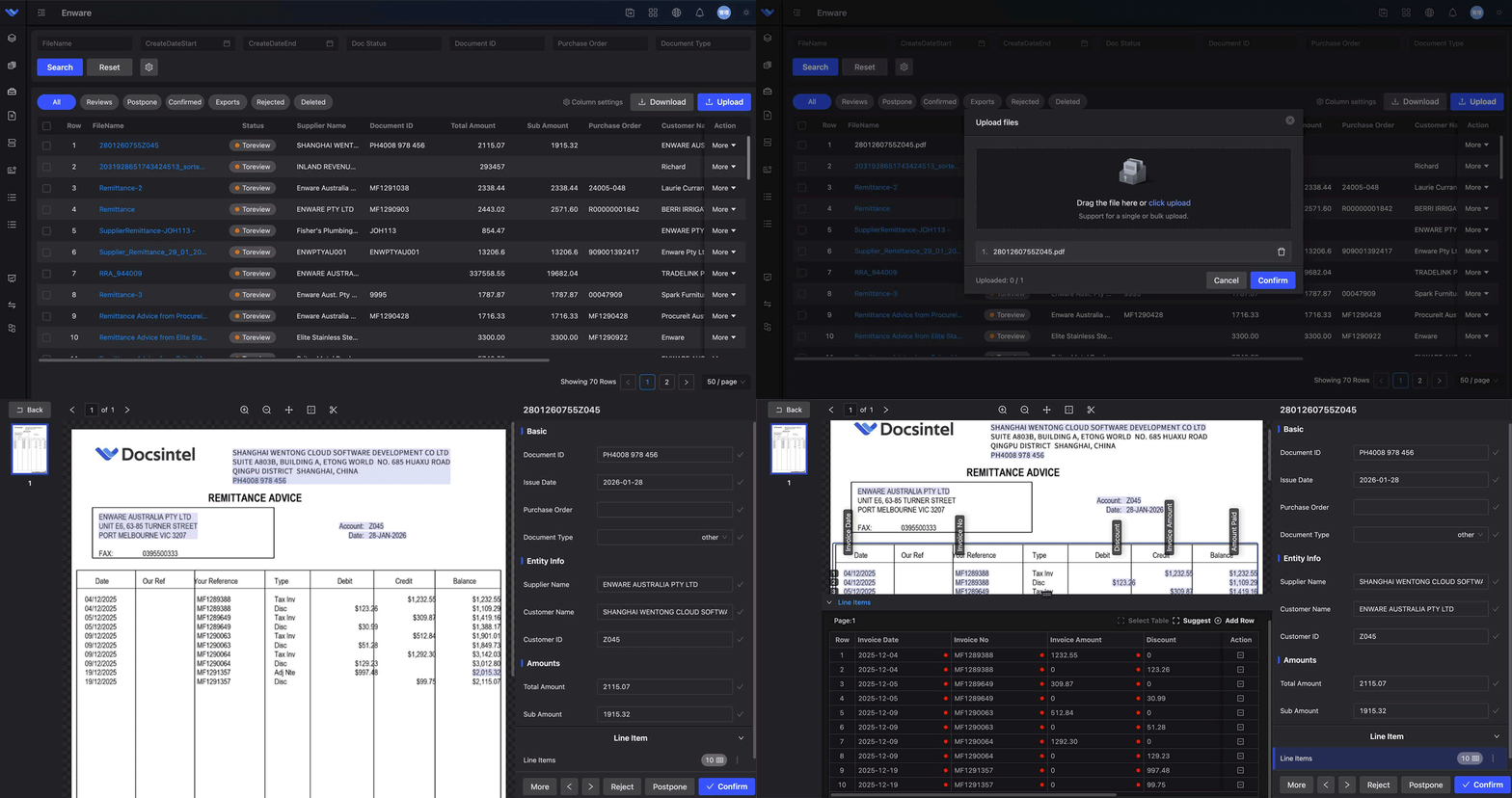
From a layout standpoint, this sample is not especially complicated. It contains payer and supplier information, dates, a reference number, a supplier code, line-level invoice details, and summary fields such as Discount, Rebate, Net Payment, and Total Paid. The difficulty is that the system does not simply need to see these fields. It needs to understand how they fit into the settlement logic.
For example, the system has to determine whether the document is remittance advice rather than an invoice or a supplier statement. It has to determine whether a negative line represents a credit note, an offset, or a historical adjustment. It has to tell whether a discount has already been reflected in the net amount. It has to decide whether the invoice number in the document can be matched one-to-one with an open item in the ERP system. It also has to verify whether the summary amount is consistent with the line-level net amounts. None of these are character-recognition problems. They are problems of business semantics and settlement relationships.
That is also why finance teams, even after moving away from paper, still spend so much time after payment on checking, documenting, and communicating. ACCA notes in its guidance on supplier statement reconciliation that companies need accurate supplier records because reconciliation is meant to identify errors and discrepancies in the accounting record and prevent omissions, duplication, and mismatches between the books and the underlying transactions. In other words, once the payment goes out, the real reconciliation work often starts.
Why This Matters More Now
One clear trend is that business payments continue to become more digital, while the explanatory layer around settlement has not disappeared. The Federal Reserve’s 2024 Business Payments Study shows continued growth in ACH, physical cards, mobile wallets, and instant payments, while companies still rely on long-standing payment methods as well. More digital payment execution does not automatically produce more standardized reconciliation data. If anything, it creates more situations in which the cash flow and invoice flow have to be realigned through documents such as remittance advice, statements, and payment advice.
So the issue companies face today is no longer just the old problem of turning paper into digital files. The harder problem is this: in a digital payment environment, how can settlement documents be accurately interpreted by machines and pushed into a closed business loop? That matters even more in high-frequency B2B settings such as building materials distribution, industrial trade, spare-parts supply chains, and fast-moving consumer goods (FMCG) channels. A single payment often covers multiple invoices and may include discounts, rebates, credits, and historical variance items. On the page, the document may look simple. In practice, it touches AP, procurement, supplier collaboration, month-end close quality, and audit traceability.
OCR Can Read the Document. It Still Cannot Reconcile It.
This is a strong fit for intelligent document automation not because the document contains a lot of text, but because it combines three characteristics that matter: the documents come from multiple sources, the layouts are not fully standardized, and the most important information sits in tables. On top of that, the extracted content only becomes useful once it enters business rules and system matching.
A workable solution usually does not stop at field extraction. It operates in layers. First comes document classification to determine whether the file is remittance advice, an invoice, a statement, or credit advice. Then comes layout analysis and table-structure reconstruction to extract line-level data such as invoice number, amount, discount, rebate, and net payment. The extracted results then need to be matched against ERP open items, supplier ledgers, payment batches, or the AP subledger. Finally, anything that cannot be closed automatically needs to be routed into an exception queue for finance or procurement to review.
That last step is critical because what companies usually lack is not recognition capability. What they lack is the ability to turn document outputs directly into data objects that are clearable, traceable, and auditable. OCR can tell you what the characters are. Intelligent Document Processing (IDP) tells you what the record means in business terms and where it should go next. With settlement notices that include negative offsets, discounts, and multi-invoice mapping relationships, that distinction becomes even more important.
The ROI Is Bigger Than Labor Savings
If this type of project is defined only as a way to reduce manual data entry, the ROI will be badly understated. What consumes finance teams’ time is usually not typing invoice numbers into a system. It is the follow-up work afterward: checking, tracing, supplementing documentation, answering inquiries, and closing discrepancies.
Ardent Partners’ 2025 AP Metrics Report provides a useful benchmark: the average AP organization takes 9.2 days to process an invoice, at an average cost of USD 9.40 per invoice. Those figures apply specifically to invoice processing, but they point to a broader reality. As long as a process still depends on heavy manual judgment, cross-system lookups, and exception handling, the cost stays high. For non-standard settlement documents such as remittance advice, supplier statements, and credit advice, that manual burden is often even heavier.
From a management standpoint, the more important gains are indirect. If payment explanations can be understood automatically by the system, more open items can be cleared on time, more exceptions can be identified before month-end close, and more supplier questions can be answered internally rather than through long email chains. That improves uncleared-item visibility, month-end efficiency, and cash-flow transparency. It shortens supplier dispute cycles. And it moves the settlement process away from manual interpretation toward system handling with human review reserved for genuine exceptions.
The Path Is Already Proven
This is not just a theoretical argument. Public case studies already show that in high-volume environments, once document automation extends into matching and reconciliation, the benefits become much more direct than simple data capture.
In Medius’s published case on J.J. Taylor, the company had to process invoices with hundreds of line items, and manual matching made bottlenecks, forecasting, and accruals harder to manage. After automation, the process achieved a much higher level of automated intake and automated matching, while improving payment planning and financial visibility. The example is about invoice automation, but it points to the same underlying issue: when documents contain many lines, matching relationships are complex, and downstream interpretation is expensive, the value of automation rises quickly.
More importantly, companies today are no longer satisfied with merely extracting data from documents. The projects that actually make it into core finance and procurement workflows are usually aiming for higher straight-through processing (STP), fewer manual exceptions, and shorter reconciliation cycles. At that point, the benefit is no longer just efficiency. It is stronger operational control.
A Better Way to Define the Project
Projects like this often go off track when the goal is defined as “build a recognition template” or “reach 95% accuracy.” Those targets may sound clear, but they usually trap the team in narrow technical metrics and do not answer the questions management actually cares about: Have exceptions gone down? Have uncleared items been reduced? Are supplier disputes closing faster? Is month-end close faster? Is there now an auditable processing chain?
A more useful way to define the project is this: address fragmented payment explanations, low reconciliation efficiency, and slow exception closure by building an IDP-centered approach to settlement document automation that increases auto-clearing coverage, shortens reconciliation cycles, and improves exception traceability.
Once the project is defined that way, the technical path aligns naturally with the business goal. Document classification is no longer done for its own sake, but to route each document type into the right workflow. Table extraction is no longer just about capturing fields, but about reconstructing settlement relationships. And the rules engine is no longer there to accumulate complexity, but to release the cases that can close automatically and isolate the ones that genuinely require human judgment.
A B2B remittance advice document may look like an ordinary attachment in routine financial correspondence. In practice, it is one of the most underestimated and most automation-worthy documents in the enterprise settlement process. It connects more than payment amounts. It connects invoice detail, discount treatment, credit offsets, open-item clearing, supplier communication, and audit traceability.
As long as companies continue to rely on people to interpret these documents, the system may complete the payment, but it still does not truly own the settlement process. The value of automation only starts to appear when the document can be converted consistently into structured outputs and connected to AP, ERP, and exception-handling workflows.
So when evaluating whether an IDP initiative has really entered the financial core, the question is not only whether it can recognize invoices. It is also whether it can handle settlement and reconciliation documents like this one. The companies that can turn “payment completed” into “accounting automatically explained, discrepancies surfaced in time, and full traceability preserved throughout” are the ones most likely to turn AP automation into an operating capability rather than just a productivity tool.